
K
Kharcha · Money, matters.
One app that tracks what you spend, splits what you share, and budgets for a better tomorrow
Managing money is no longer a solo activity. Every Indian money
app is still built for one person doing one thing.

Role
Product Designer, Researcher, Managing
TYPE
Self-Initiated
Scope
One App solution for Indian financial Use-case.
Timeline
1.5 month — Ongoing
Context
This redesign project explores a comprehensive financial management and budgeting solution tailored to the diverse needs of users in India. It is designed to support everyone from beginners taking their first steps toward financial planning to freelancers and couples managing separate financial responsibilities, relationships, and goals. I initiated the project after identifying a gap in the existing budgeting app landscape: no single product effectively addresses the full spectrum of real-world financial use cases.
Re-Designing Budgeting Solution for indian Users, From Fix Erner to a Freelancer.
Crafted a Problem Statement.
Do You thinking managing money is a solo Activity today in india ?
The Answer is No"
Whether you live independently, share a home with a partner or flatmates, or have settled into family life, one relationship stays constant: your relationship with money.
Yet managing finances still means juggling multiple apps for budgeting, payments, savings, and tracking. Most platforms focus on how they collect your financial data rather than the real-life needs they help you manage.
People do not need more disconnected finance tools. They need one simple, thoughtful platform that brings their everyday financial life together.
Most budgeting apps are designed around a single use case. Few adapt as your life changes.
Product offering
What make us stand out

50/30/20, Try what suits you
Smart Financial Calculator

The subscription he forgot
Unused since May. ₹1,788 a year,
surfaced with one action.

We care about your financial maturity
Make him aware about his action
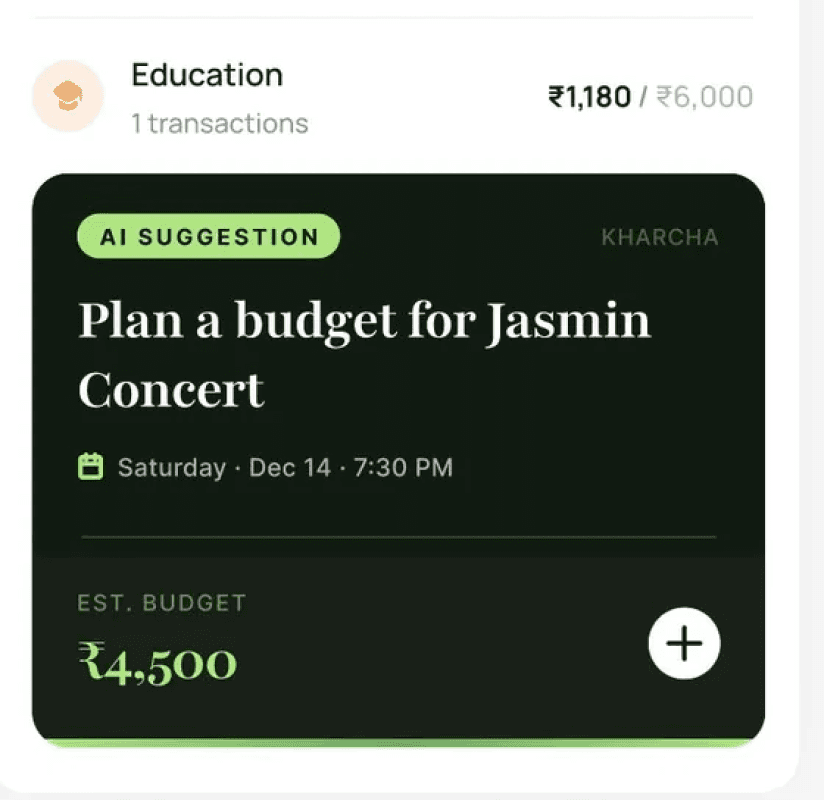
Underspent? Do something
with it
A concert with a budget attached —
or the same amount into an SIP.
Secondary Research
Before designing anything, I wanted to see what
an Indian earner already has to choose from.
Competitive Analysis
Who captures what, and what
you get for it
Ten apps people here actually use, sorted by how they collect your
spending rather than by how they market themselves.
App
How it collects your spending
What it offers
Walnut / Axio
Reads your bank SMS
Tracking
Bill reminders
Basic budgets
no splitting
no partner view
Money View
Bank SMS, optional account link
Tracking
Budgets
Bill reminders
no splitting
no partner view
Jupiter Money
Linked bank accounts
Auto-categorised spends
Budgets
Net worth
no splitting
no partner view
Fi Money
Neobank and linked accounts
Budgets
Spending insights
Savings
no splitting
no partner view
Splitwise
You enter everything yourself
Bill splitting
Debt simplification
Receipt scanning
no budgets
no monthly totals
Goodbudget
You enter everything yourself
Envelope budgets
Shared envelopes
no splitting
no automation
Spendee
Manual, optional bank link
Visual budgets
Shared wallets
Some splitting
no full splitting
FinArt
SMS, email and notifications
Budgets
Family sharing
Renewal alerts
no splitting
Pocket Clear
Nothing leaves your phone
Budgets
Partner mode
no splitting
no automation
Cred
Linked cards
Card rewards
Light budgets
no splitting
no partner view
offers this
doesn't
Only one app here splits bills properly and it's the one that doesn't budget at all.
No app prioritise Partner share login with join account.
User interview
The market told me what exists. my user told me why none of it sticks.
He wasn't missing a feature. He'd stopped believing the total.

Deepak, 34
Salaried · Tier 1 city
Running two apps
In his words
—
"Not sure which one is secure enough to link my bank to."
—
I am just spending without any guide what is best way to spend.
—
"The same expense shows up twice across my two apps."
—
"App doesn’t add any much value into my financial life "
—
"A lot goes unrecorded charity, a neighbourhood
Every route to an honest total was blocked by something he didn't trust — the
permission, the discipline, or the maths.
Synthesizing findings
What kept coming back
Looking finding from the lense of Opportunity
01
Most apps compete on how fast they read your bank messages
Reads your SMS, links your bank, or makes you type it in. What happens after barely changes between them.
What this uncovered
Compete on what happens after the money is in.
02
Almost nothing is built for partner goals
Where partner features exist, they were added to an app made
for one user. Sharing ends up all or nothing.
What this uncovered
Let people say who they share money with first, then build
around it.
03
Bill splitting sits outside budgeting, everywhere
The best splitting app doesn't budget. The budgeting apps don't
split. The totals never agree.
What this uncovered
One ledger. Settling up with a friend updates what you can
spend.
04
Every app assumes your salary arrives on the same
date
Setup asks for a pay date. Freelancers and gig workers break
the app on the first screen.
What this uncovered
Ask for the shape of the income, not the amount.
05
No app cares about your calculations or your
financial maturity
Every app reports what you did. None tells you what to do, or
whether you're doing well.
What this uncovered
Put learning in the product: a calculator, a score, short
reads.
One Question i Summaries My Finding with
Every app answers where did my money go? — for one kind of person, doing one thing. It looks backwards, and it only fits while your life stays still.
How might we design one app that adapts
to every use case and makes earners
confident about what they can commit to
next?
My target Audiance
Two Persona the market designs around, not for

Ishaan, 24
The new earner · ₹25–60k/mo · flatshare
Pain
Apps assume a total beginner or someone with EMIs. Nothing
sits in between.
Need
A safe-to-spend figure, and splitting in the same place.

Karan & Aditi
32 & 30 · Homeowner couple · 20-year EMI
Pain
Nothing here is built for a couple with a home loan. Sharing is
all or nothing.
Need
One shared view of what's free after the EMI, with private
categories underneath.

Farhan, 30 — the freelancer
No fixed payday. Breaks every app that assumes one.

Sunita, 31 — the anchor
EMIs, school fees, money sent home. Misses payments on timing, not funds.
Persona
Understanding From User lense

Journey
The new earner

Journey
The homeowner couple
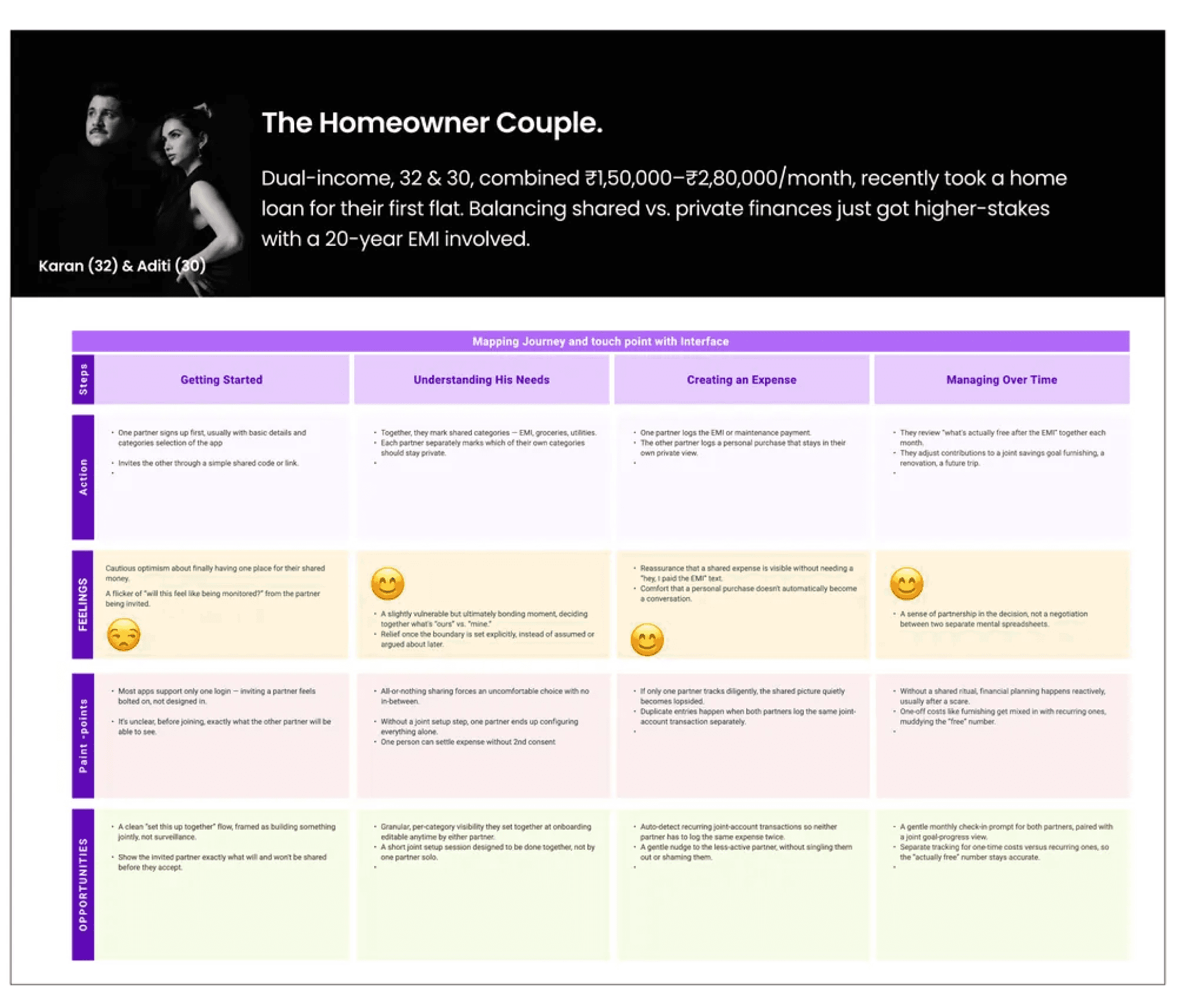
Both journeys stall at the same two moments: being asked for bank access too early,
and one partner setting everything up alone.
The whole app, before any screens
Information Architecture

Scroll within the frame for the full tree.
Mapping every branch first is what surfaced the account-
type question.
Single, couple, or household has to be answered at
launch, because almost everything below it changes with
the answer.
The decision that shaped everything
Most apps are built for a single persona. Kharcha is built for shared money from the start.
Design Decision
A real joint account for couples
Two logins, one shared picture. A couple can keep their own
goals separate from household ones or from a friends' group,
and still see where their partner's money is going — without
handing over everything.
Money going below the table
Finds the subscriptions you pay for but stopped using, tells you
what each one is costing you a year, and either nudges you to
cancel or turns off auto-pay on the linked app for you.
A smart financial calculator
For someone new to earning who doesn't know finance yet: it
shows how much of his income should go to spending and how
much to saving under the 50/30/20 rule, and makes the maths
easy to play with.
A financial maturity test
The app builds a test from that person's own activity, so taking it
tells them where they actually stand — and makes them a little
more financially intelligent each time.
WHAT MAKES IT STAND OUT
Design Solution.....
Three of those decisions carry the product. None of the ten apps I audited
does any of them.
01
The money leaving quietly
A few hundred rupees a month leak away on unused subscriptions. The app tracks both usage and charges, and warns you before renewal.
1
“Gaana Plus hasn't opened since May.” Usage is what flags it, not the size of the charge.
2
Some expense starts mattering when calculation change the picture of it. ₹149 a month is easy to ignore. ₹1,788 a year is not.
3
Cancel it, or switch off auto- pay on the linked app, without leaving the screen.
4
Three days before it renews : Early enough to be a decision
rather than a refund request.


02
App care’s about your financial maturity.
Every app in the audit reports what you did. None tells you
whether you are handling money well for someone in your
situation.
1
App frame question based on his own activity Built from his own activity.
2
Nobody else here offers it Financial literacy is the stated
need of every new earner in the research, and absent from all
ten apps.

Two-minute reads
Placed next to the number that raised the question
what an emergency fund actually needs to
cover, and so on.


03
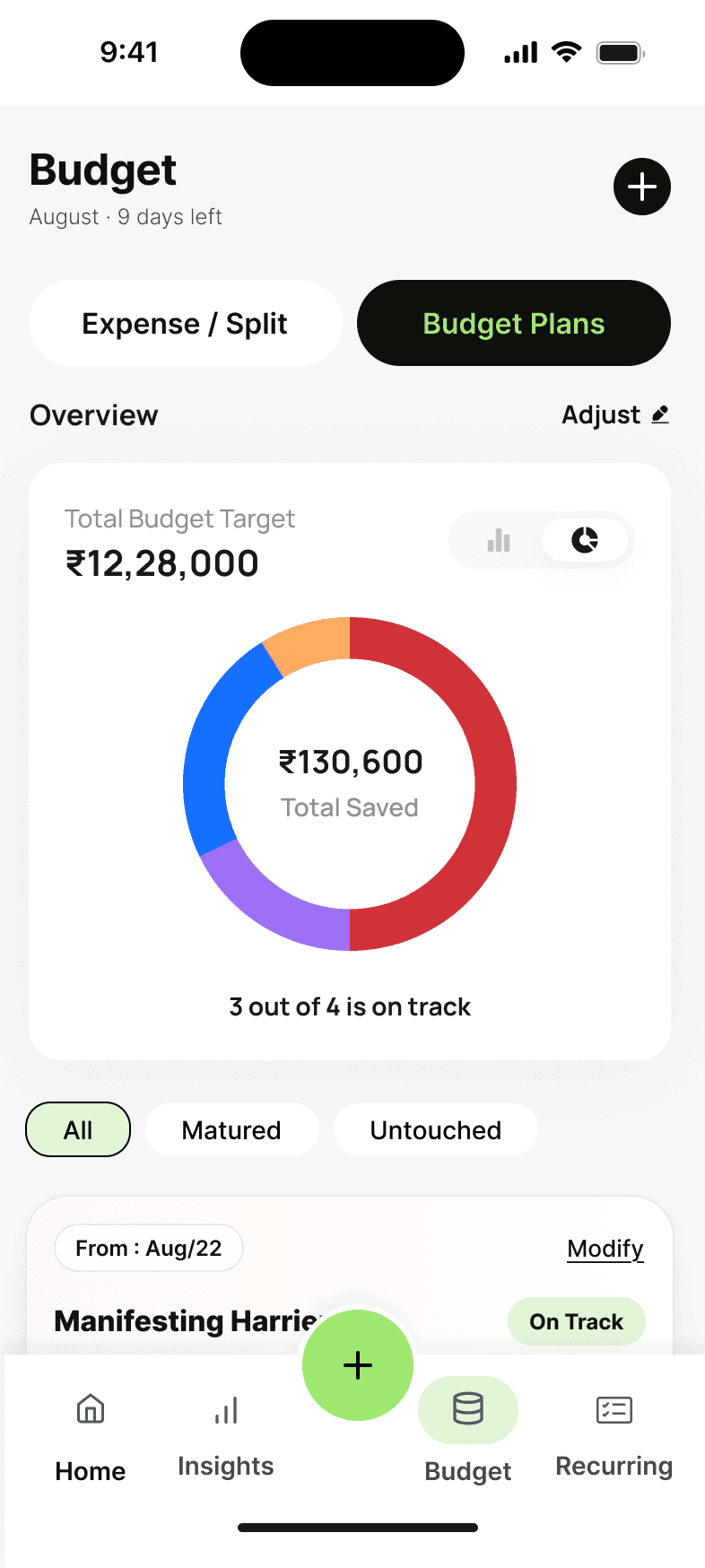
Nudges for the money you didn't
spend
Every other app speaks up when you overspend. When two or
three categories come in under, that surplus quietly disappears
into next month and nobody notices. Here it becomes a decision.
1
Your underspending also get noticed.
2
Spend it in shaping better future plan for investment
3
Spend it on your life-style,

04
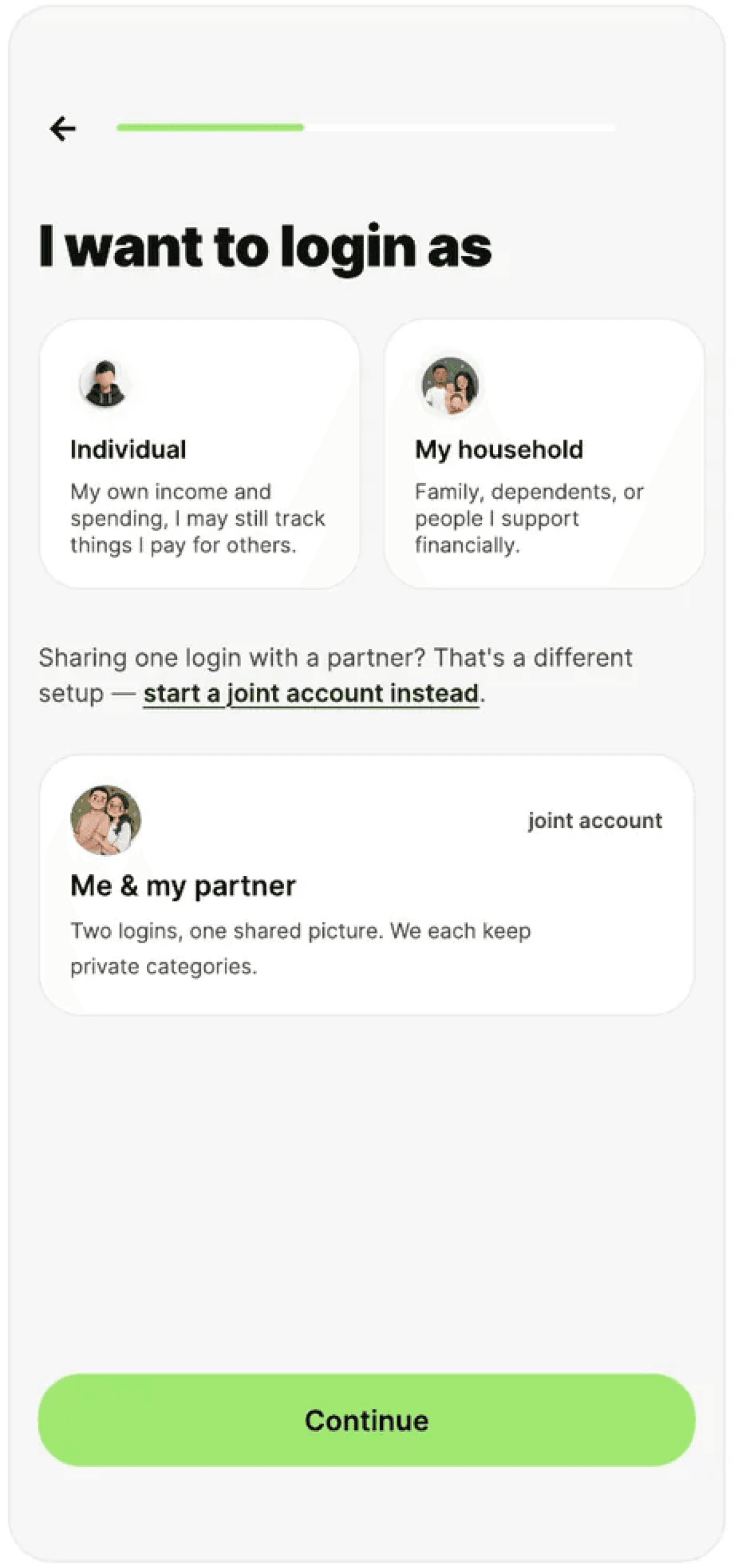
Ask who this is for before asking anything
about money
This app build for all different type of user and their needs so it ask how user wanted to login as,
1
Each User type has their personal and shared expenses.
2
Partner login kept Separated because that supports a new architecture, And it works as join account.
3
Featured is mapped based on login-type
05
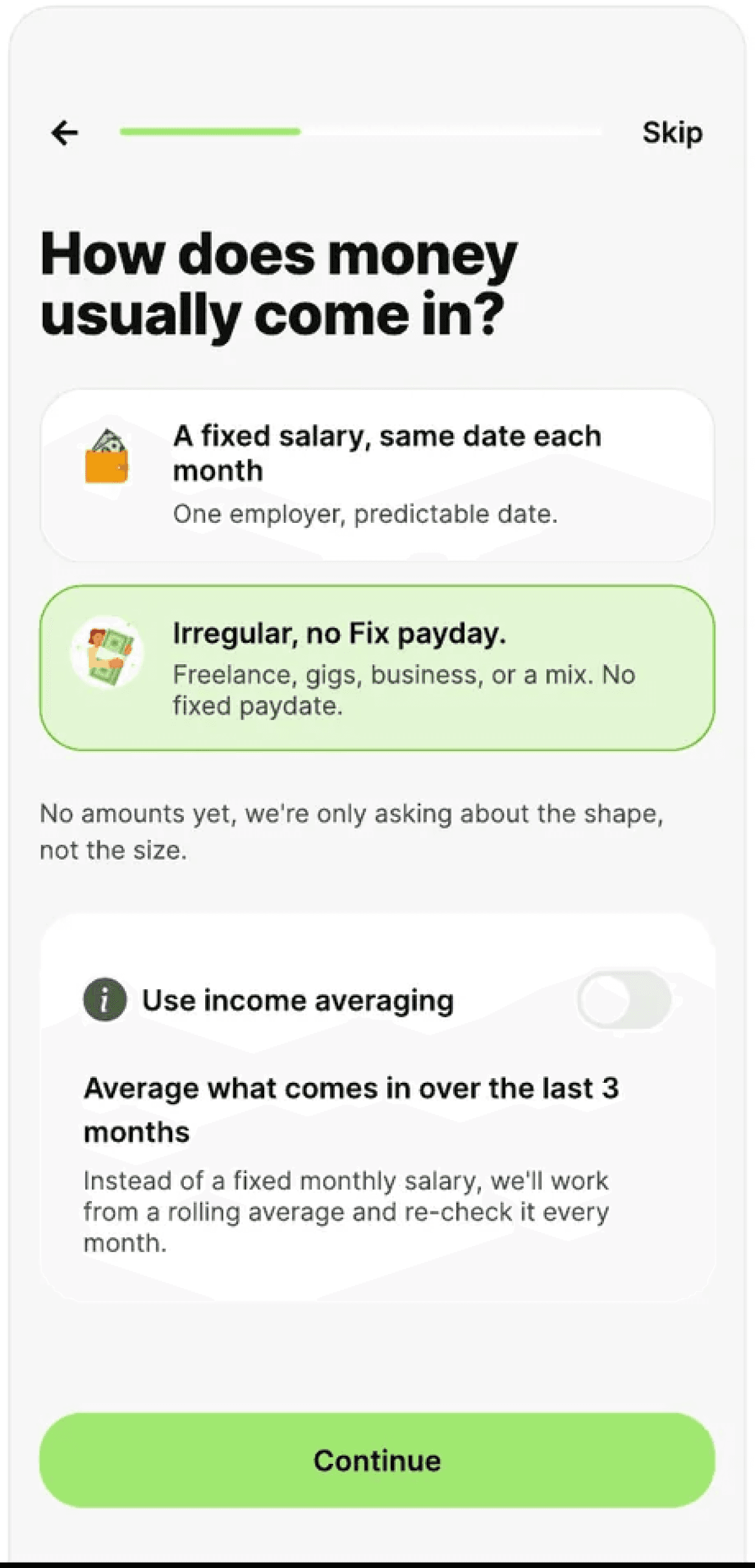
A feature build for freelancer or irregular income
Rather then operating in monthly cycle app start taking a 3 month of cycle to analyse income and spending.
1
One month with no icons. App doesn’t scare you with negative value
2
The app works by averaging all bits or pieces of income into one.
3
Averaging, is still an option based on the user's preference
06
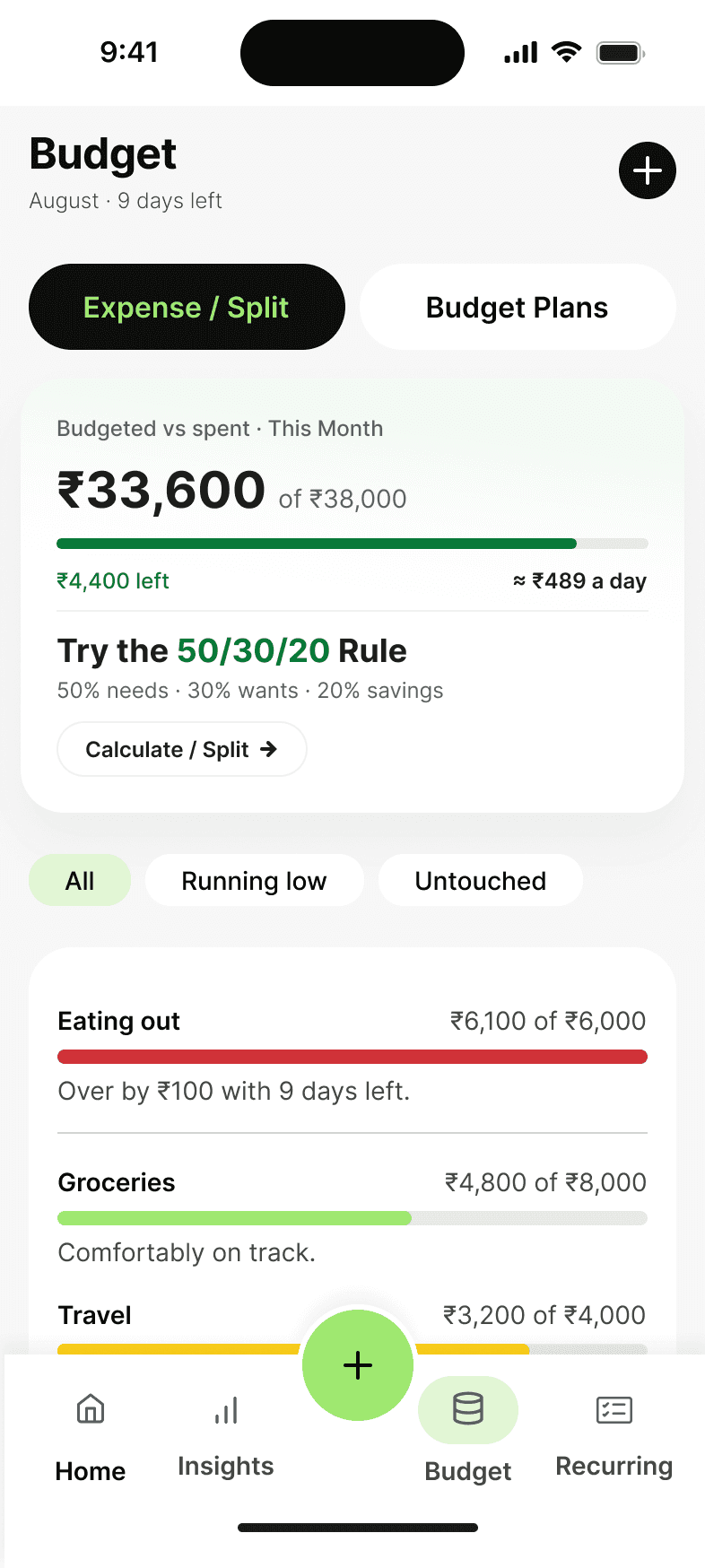
Plan with a proven method, not
a guess
A first-time earner doesn't need another chart. He
needs someone to tell him how much of his income
should go where. The budget screen offers
established saving methods — 50/30/20 to begin
with and applies them to his actual income
instead of explaining them in an article.
1
Calculate / Split divides his real income into needs, wants and savings on the spot.
2
Run the same month through a different split and see what it would have meant.
3
Try all proven financial path to shape your expense and budgeting

The decision that shaped everything
Final Shipped Screens......


Dashboard / Budgeting / Expense, Split


What i learned.
Research is the backbone
I started knowing only that something was blocked. The opportunities came out of the
process, not before it.
Not Every Problem can be solved in one product or system.
What I designed isn't everything I found. Each problem has its own weight and its own
moment.
Reflection
What i would do in 2nd Phase.
Focus More on Primary Research Need diverse Users and insights.
One conversation can't validate four personas. They're reasoned guesses, and I'd call them
that.
Couple onboarding needs Changes on Architecture of the App
Testing them together hides the discomfort I'm designing against.
My learning: not everything can be packed into one package.
What I left out
Investing and wealth tracking
Once an app sells investments, the budgeting suffers. Several apps in the audit show this.
Credit-card rewards
A different motivation entirely, and a crowded space.
Lending
An app that profits when you borrow can't credibly tell you to stop.